
Deconstructing Calvinism
"When you come to realize that your decision to believe in determinism was itself determined and that even your present realization of that fact right now is likewise determined, a sort of vertigo sets in, for everything that you think, even this very thought itself, is outside your control. Determinism could be true, but it is very hard to see how it could ever be rationally affirmed, since its affirmation undermines the rationality of its affirmation."
~ William Lane Craig
Recommended to follow this order of reading because the calvinistic framework is built upon many interlocking presuppositions built on other presuppositions. But first, scroll down to read the acronyms and other info:
What is God’s Wrath?
Moral Exemplar: God's Humility
A Defense for God’s Glory
Is Divine Determinism Biblical? by Clay Jones
A Refutation of Divine Determinism
Theodicy: A Defense for God in the Face of Evil
Original Sin & Children
Romans 7 is Not What You Think
Contra Total Depravity:
Part 1: Does Dead Mean Dead?
Part 2: The False Identity of Total Depravity
Part 3: Does Romans 3 Teach Total Depravity?
Part 4: Are We Born with Hard Hearts?
Part 5: Romans 9: Does God Harden People into Reprobation?
Part 6: Are People Born Deaf and Blind to The Truth?
What is Faith? Is Faith a Gift from God?
Order of Salvation (Ordo Salutis)
A Critique of Lordship Salvation
Provisional Atonement vs. Limited Atonement
Contra Irresistible Grace
Contra Unconditional Election:
Part 1: Did God Choose You or did You Choose Him?
Part 2: The Early Church on Ephesians 1:4
Part 3: Predestination or Predetermination?
Part 4: 2 Thessalonians 2:13 Does Not Teach Calvinistic Election
Part 5: Election in Romans 9-11
Part 6: More coming later...
Corporate Election and Election to Service in Romans 9 by Leighton Flowers
Eternal Security: Can You Lose Your Salvation?
The Calvinistic Framework of TULIP
Navigating Deconstruction

Provisionism / Arminianism / Non-Calvinism Posts
God's Nature & Attributes Posts
Provisionism, Wesleyan Arminianism, Calvinism, Molinism Acryonyms


Resources:
“It amazes me that Calvinists will attack Charles Finney as this terrible, heretical monster, and yet they defend a man like John Calvin. See, I would take seventy-two percent of converts that remained in the faith (387,000 saved) over the track record of say, John Calvin, who, as far as we know, never led a single lost soul to the Lord. Not one testimony can be provided of John Calvin winning a sinner to Christ (0 saved & 58 people killed = negative 58).” ~ Jesse Morrell
Quote from Jesse Morell at 9:41 here. Discovered in research on atonement theories (Just poking fun here). The negative number is because John Calvin burned people at the stake (a Unitarian and Anabaptists) for disagreeing with him. Did God sovereignly determine him to do this so he could not have done otherwise? Did God withhold His grace from him so as to allow him to do this sin? If so, does that make God responsible? But if it was by his own free-will, do you think that his actions were taken because they were a reflection from his concept of God? Why do you even think it is wrong to burn people at the stake? After all, if you believe God literally burns people in hell for eternity, wouldn't the actions of John Calvin in deeming these people to be heretics and reprobates simply be like sending people off into their maiden voyage to hell? What makes such a thought of someone burning another person alive reprehensible? Is it the Holy Spirit's nudge? The conscience? The law of God written on our hearts?
If determinism is true, how can you actually sin against God? How can you deviate from God? How can you go against what God wants if it was His plan all along for you to sin? In that case, by your sinning, you are fulfilling the will of God. But that can’t be true, can it? If God is the one determining sinful actions and this choice is made logically prior to any choices mankind makes, then the only one in the universe actually choosing evil is God.
But don't just appeal to mystery at this point as a cop-out. Face the problems of this system. You don't have to believe this. There is an alternative. But you will have to dedicate yourself to study and learn through this entire course. Suppressing your thoughts won't make this problem go away. It will linger in your subconscious mind and hinder your spiritual growth. God wants us to believe in Him not just with faith from our hearts but from our minds as well. It is dangerous when the mind is not aligned with faith. Determinism and Calvinism were never meant to be the way we understand God.
If you would like to know Calvinism in a nutshell while also having a good laugh, check out this video here
Also, check out this Provisionism / Arminianism / Non-Calvinism YouTube playlist here
Theistic Determinism vs. Free-Will YouTube playlist here
Very well-written argument and article against Divine Determinism here
For a further understanding of tenants of belief added over time to Augustinian-Calvinism regarding the atonement, here is a video. Not every claim is necessary to adhere to in order to believe PSA:
What is Penal Substitution? Reviewing PSA's 17 Claims
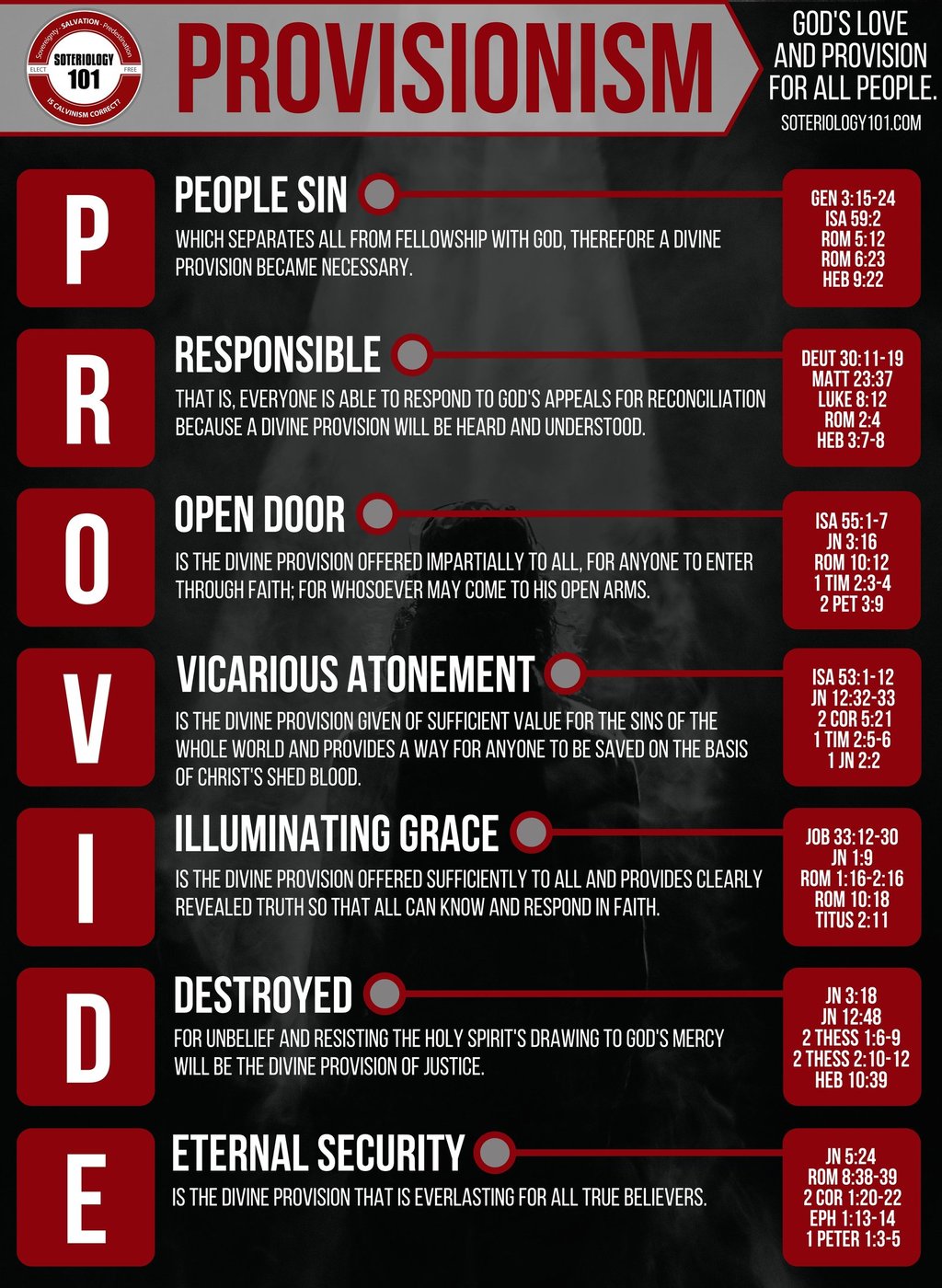
Provisionism Acronym source here
Note: I am not 100% Provisionist but it is a very good model and I am indebted to Leighton Flowers for all his hard work.
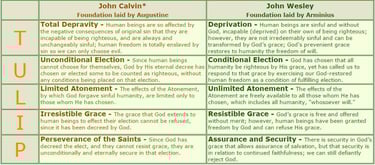
Calvinism and Arminianism Acronym here
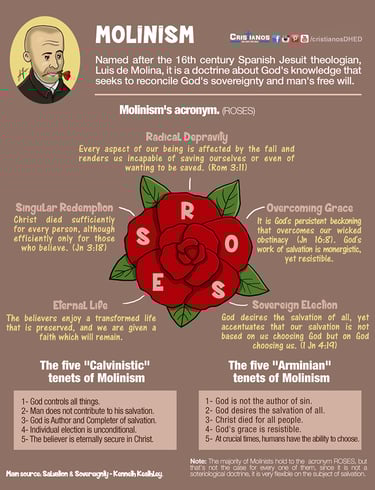
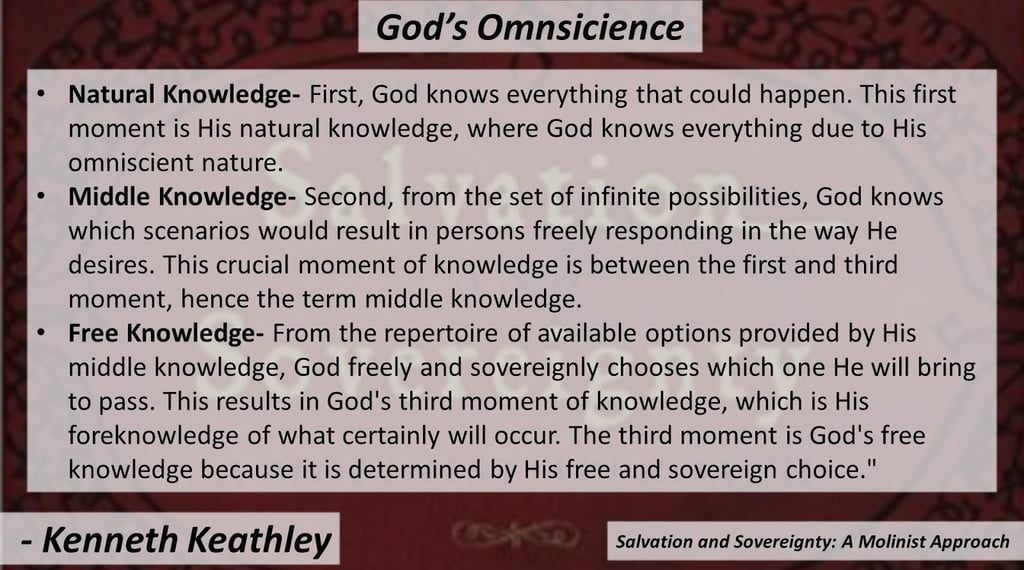
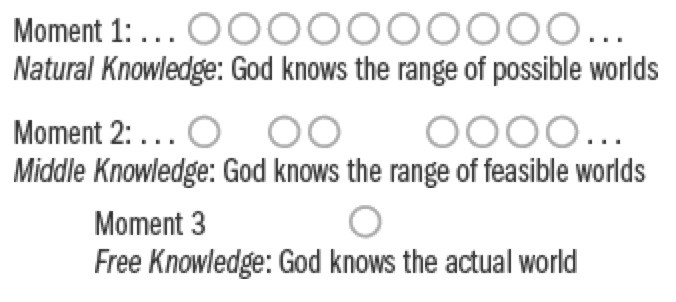
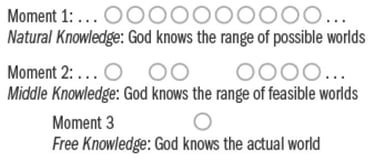
Molinism Acronym here & Middle knowledge graph here
HEART THEOLOGY acronym
To know what the Reformed and Calvinists believe from their perspective, you can see the 1689 London Baptist Confession of Faith
More information about the Acronyms/graphs:
Limited Atonement has been developed further since John Calvin and is even more restrictive in its common understanding today where they say that it's not just the effects but the Atonement itself which is limited only to the chosen elect.
Arminianism holds to more of a depraved view of man's sinfulness more similar to the Calvinistic view, except they have "Preveniant Grace" which comes before and enables a sinner to voluntarily believe. Whereas the Wesleyan, Provisionist, and Eastern Orthodox view of man's sinfulness is not so bleak. The Arminianian view of eternal security is also like that of the Calvinistic view in that it is unconditional eternal security whereas a more Wesleyan view is conditional eternal security on the condition that faith and/or faithfulness continues to the very end.
Molinism is an alternative way to understand how God conducts His sovereignty while still allowing human freedom. Middle Knowledge is the core tenant of this. It has a high view of God's meticulous control over creation and future events while still leaving humans with contra-causal free-will.
How salvation and God's sovereignty work in the different models:
In Molinism, God creates the most feasible world where He foresees that given those certain circumstances and conditions of which the world may possibly be, particular people would be drawn to Him and respond to His grace and so effectually be saved so that the most number of people are saved yet without interfering with their liberty to choose, and for God to also work out everything in the universe according to His divine purposes. From this, He actualized such a world out of all conceptually possible worlds by creating that world. In this way, His choice for saving people is harmonious with both His sovereign control and the freedom of all creatures. Molinism is somewhat of a middle-ground between Calvinism and Arminianism.
In Calvinism, (rooted in Augustinian teachings), many believe that God’s choice of a select group of people is made first, then He controls things meticulously so that those particular people are sure to be saved no matter what, irrespective of their choice. To the Calvinists, God’s foreknowledge is basically the same as His sovereign choice/decree. God’s choice is logically prior to His foreknowledge. In this way, God knows what will and will not happen because He determines what will and will not happen.
There is also the lapsarian debate, which I honestly think is a moot point. The reason being, if God saw all the future or possible futures, and the free-will of man is not at all a determining factor for making any of His choices, then it doesn't make a difference at which logical order He decides to decree things since He already saw what was going to happen and was going to do what He wanted to do anyways.
“By predestination we mean the eternal decree of God, by which he determined with himself whatever he wished to happen with regard to every man. All are not created on equal terms, but some are preordained to eternal life, others to eternal damnation; and, accordingly, as each has been created for one or the other of those ends, we say that he has been predestined to life or death.”
~ John Calvin, Institutes of the Christian Religion, ch. 21, sec. 5
This is called "double predestination" which many Calvinists would deny believing though their denial is simply a refusal to accept the logical conclusion of their system. If God withholds His grace from some people (by which they could not be saved otherwise), then it is ultimately because God doesn't want them to be saved and would delight in one way or another, to see them perish or to burn in hell forever. But if God does not do this because it ultimately pleases Him (as He is in control of all things and accomplishes all His purposes), then the other conclusion would be that His nature is not unified within Himself but rather, His love and mercy are pitted against His justice, wrath, and holiness; and He is forced to act against what He desires. This would then be a denial of God's Oneness, Unity, and Immutability. Not to mention, His very nature of love revealed to us through Jesus Christ, who the Father did not send His Son into the world to condemn it but to save it (Jn 3:17). For this reason, any debate against Calvinism needs to start with understanding the very nature of God, defining His glory, justice, wrath, holiness, love, desire, and to not forget that Jesus reveals to us the Father's heart. Oftentimes, too much emphasis is placed on textual interpretation than it is on the nature of God and one's vision becomes myopic.
So then, under the Calvinistic framework, God is either one or more of these things: (1) He works contrary to His own nature and is not unified, (2) He ultimately wants to burn people in hell forever to magnify the glory of His wrath and justice and created these people for that sole purpose, (3) He says that He does not delight in the death of the wicked and desires no one to perish, suffer, and desires all to be saved, yet He determines salvation impossible for them to attain, He created them that way, set up the world that way, He withholds His grace from them, chides them for not obeying Him or turning to the truth, yet holds them responsible for their inability, and says that He was just kidding about desiring any good for them through His actions. (4) In this way, God has borne false-testimony which is okay for Him to do because He is God and it is somehow not sin for Him to do but yet He punishes every individual who lies and thus, God has double standards. (5) God is sadistic in the sense that He delights in seeing people suffer and to be lost since no actually attainable provision of grace was made or decreed for them to receive. (6) Since predestination is all up to Him and He only does what is best according to His purpose and good pleasure, He sovereignly decreed more people to be sent to hell than to receive eternal life because He saw that to be fitting. (7) God still holds mankind responsible for all their sin (though they are unable to do otherwise) and is somehow still able to call Himself holy, loving, just, upright, blameless, gracious and compassionate and abounding in lovingkindness and truth. (deeply think about every attribute there...). By the way, I'm not trying to be mean. I'm just showing the logical conclusions.
Calvinistic beliefs exist on a spectrum of hyper-Calvinist (high-Calvinists who are pacifists) to Compatibilists (those who maintain two logically contradictory beliefs and are content to live with and suppress their cognitive dissonance), to Calvinists who do not hold to all five points of the TULIP acronym. Calvin and the other Reformers did not hold to Limited Atonement though most Calvinists hold to that today. All of the big names and all who identify as Calvinistic in their Soteriology today, would likely be Five-Point Calvinists. People are typically inclined to become Calvinist because of its appeal to "a high view of God" regarding His sovereignty, its deep exegetical and intellectual teaching, the popular teachers and most online resources are Calvinistic, they never receive a proper explanation of good non-Calvinist doctrines of election, and they typically come out of and want to get away from the shallow churches of emotionalism, prosperity gospel, me-centered Christianity, and the "name-it and claim-it" culture. Their intentions are good and there are many nice Calvinists who are genuine Christians, yet they just leave one error to embrace another. I myself was a Calvinist for 15 years but left after I heard Leighton Flowers' arguments on YouTube as I was preparing to have a mock debate against another Calvinist on the idea of Prevenient Grace. I listened to more and more of his videos and everything made rational sense. All that he said was feasibly possible to believe and to conclude regarding logical arguments and Scriptural interpretation. Eventually, I came to the point where I just paused and asked myself, "so why am I a Calvinist?"
Let’s assume a few things for a moment, shall we? Let’s assume that (1) you are a Calvinist, but you are also wrong about TULIP. (2) That salvation is attained through the exercise of the will to put faith in the demonstration of God’s love on the cross and to believe in the goodness of the Father. (3) Assurance of salvation is also based upon faith in God’s goodness. (4) People are prevented from believing in God or choose to apostatize from the faith because they cannot reconcile a good God being what your concept of God is. (5) Even if you don’t feel it or perceive it, your belief in God’s goodness is suppressed and the level of your faith in God could be stronger to give you greater victory over sin and greater fervency for serving God if you were not to believe TULIP.
So then, for the sake of argument, let’s say all these things are very possible to be true, they all have to do with faith or not in the goodness of God, and you are also wrong in your beliefs about TULIP. At what cost and at what loss is believing in your concept of God to result in for both yourself and for others? This is the potential cost when God’s power is exalted over and above God’s love, grace, and compassion, and what the cost is of abandoning man's contra-causal free-will. It also goes against and undoes all the hard work Jesus put into proving and showing the Father's deep and abundant love for humanity, stripping the message of the cross of its power. Now, I can love you in the name of Jesus as a brother or sister in Christ because God's love is abundant within me to do so. I just ask that you be aware of and carefully consider your position here because to be wrong is no light matter. I would encourage you to re-examine this doctrine so that you can be sure you are on the right side of this for the sake of your conscience, for the glory of God, for the love of all humanity, and because one day we will all stand before God to give an account of all the things we said and did, and teachers will also be judged more strictly, as you already know (James 3:1).
In Arminianism, God’s choice to save people is logically secondary to His foreknowledge. He looks ahead into the future and selects those people who He knows would choose Him and draws them by His Prevenient, enabling Grace. Jacob Arminius was a student of John Calvin and so held to the same definitions of the chosen and elect that Calvin did except Arminius just changed the logical order of God's choice and upheld human free-will. In this way, Arminianism is still very Calvinistic. Today, however, many Arminians hold to a different view called corporate election. It would be greatly wrong for Calvinists to assume that every non-Calvinist is Arminian.
In the early church, St. Jerome, St. John Chrysostom, St. Cyril, and a few others all held to beliefs similar to the Arminian one regarding the elect, free-will, and predestination, that God foreknew who would choose Him and so selected those people. People have the choice to either respond or to reject God's grace and are accountable for doing so. According to St. Jerome, man's free-will decisions to do good or evil precede God's choice, and God does not force us to believe, but it is up to the choice of our own minds. He believed that the human condition was so weak that we needed God's grace beforehand in order to repent. (source).
In the Orthodox Church, their theology reflects beliefs in corporate election for those who are elect and predestined. They do not believe in Total Depravity, and so they do not believe in the doctrine of "Prevenient Grace." They do not hold to the Reformed understanding of "Original Sin." They refer to Athanasius for their view of election.
In Traditionalism, the Southern Baptist Convention says:
“By predestination we mean the predetermined redemptive plan of God to justify, sanctify, and glorify whosoever freely believes. All people are created with equal value as image bearers of God. Because God desires mercy over justice and self-sacrificially loves everyone, He has graciously provided the means of salvation to every man, woman, boy, and girl. No person is created for damnation, or predetermined by God to that end. Those who perish only do so because they refused to accept the truth so as to be saved.”
(source no longer available). In this view, the redemptive plan of salvation is what is predetermined for whoever gets onto that train, they will make it to their destination.
In Provisionism, God’s offer of salvation and means of grace (or illumination) is given to all people sufficiently without exception and it is enough for anyone to be drawn to Christ so as to be saved and any rejection of this holds them responsible. Additionally, the call to salvation through the proclamation of the gospel is necessary for people to be saved. God has sovereignly decreed that mankind should have a contra-causal free-will (though of course not fully autonomous as it is subject to influences). Yet sin, in and of itself, does not disable or prevent that sinner from humbling himself before God to repent of his sins and to believe in Christ. God chooses those who humble themselves to come to Him in faith. But the focus really isn't on God's sovereignty or foreknowledge before eternity past as the necessary condition for God's choice. The focus is on God's choice to grace those who humble themselves (receptive action) in coming to Him in the present (within time) and to use them for His service. So, forget about the whole foreknowledge thing or fore-determining within this context because they are not the foundation for God's choice. In God's humble and selfless loving nature revealed to us through Jesus Christ, God desires to share His glory with others and to raise them up; and so He is okay and content with not meticulously controlling every single molecule in the universe and thus allows for creaturely freedom while at the same time, sovereignly orchestrates events in this world to fulfill all His purposes and unto the love of all His creation. The model of Provisionism was developed by Dr. Leighton Flowers and is a nuanced form of Traditionalism.
Provisionists hold to corporate election along with many Arminians, Baptists, and Orthodox believers:
God has destined beforehand what will happen to all those “in Christ.” But it is all those corporately in Christ, whoever might be in Christ or come into Christ, not of those who are individuals. For example, God chose Israel and all those in Israel were elect and blessed by their being in the chosen nation. But the individuals themselves were not elect unless they were in Israel. The same applies to the church age of those in Christ or in Adam (not in Christ). Predestination is to be holy and blameless to be conformed into the image of Christ (sanctification for all those already in the group of Christ). The elect are not actually called elect unless they are at the present time in Christ. In the case that specific individuals are chosen by God, it is them being chosen for service, not chosen for salvation. There is no such thing as an elect person before their regeneration.
Various Bible interpreters will have a nuanced way of speaking about election: Some emphasize the service identity aspect more while others might emphasize the redemptive plan of the future salvation of sanctification and glorification to all those already in Christ.
If we were to put all of these doctrinal positions on a spectrum of God’s power and control in exercising His sovereignty, they would be in this order: Calvinism, Molinism, Traditionalism, Arminianism (since they believe salvation can be forfeit), Provisionism (since their beliefs are the most different from Calvinism, though they do not believe salvation can be forfeit and neither does Traditionalism), and the Orthodox Church.
Please consider these positions by their merit alone and don't dismiss them simply because you think they are some fringe belief. Because, by that standard, Calvinistic Soteriology is actually the minority in all of Christendom. Even if at the end of this study, I cannot convince you otherwise, at least consider the positive benefit of this study to challenge your own presuppositions, Scriptural interpretation, to balance your mind, and to provide more humility in your thinking for either you or someone you know so as to not be so dogmatic in their theology to the end that greater Christian unity can be achieved, pride can be abolished, our identity will be established in Christ alone rather than our theology, and that the love of God and the love among believers may prevail to the glory of God.
If you would like to make this fun for yourself, prepare yourself to have a mock debate with a friend. But to do this, you will first need to have a sufficient grasp of a non-calvinistic framework in order to do this effectively. So just try to set your current beliefs on the shelf right now and get into the mind and understanding of this other theological worldview before rejecting it. When approaching Bible texts, first ask yourself, "what are my presuppositions here?" Lay it out on the table and then question yourself, "why do I believe this? What thoughts or arguments is it founded upon? And is that foundation 100 percent solid? Or is it merely built upon another presupposition?" Before appealing to mystery, understand that God is a God of order and logic, and we should seek to understand Him through our rational minds as much as we can since He gave us rational minds that we would understand and know Him.